
Flanges are the unsung connectors of every piping system. They join pipes, valves, pumps, and equipment while allowing easy assembly, inspection, and maintenance. Choosing the right type affects safety, pressure handling, and long-term performance. As a trusted steel flanges manufacturer India industries rely on, Dynamic Alloys explains the most common flange types and where each works best.
1. Slip-On Flanges
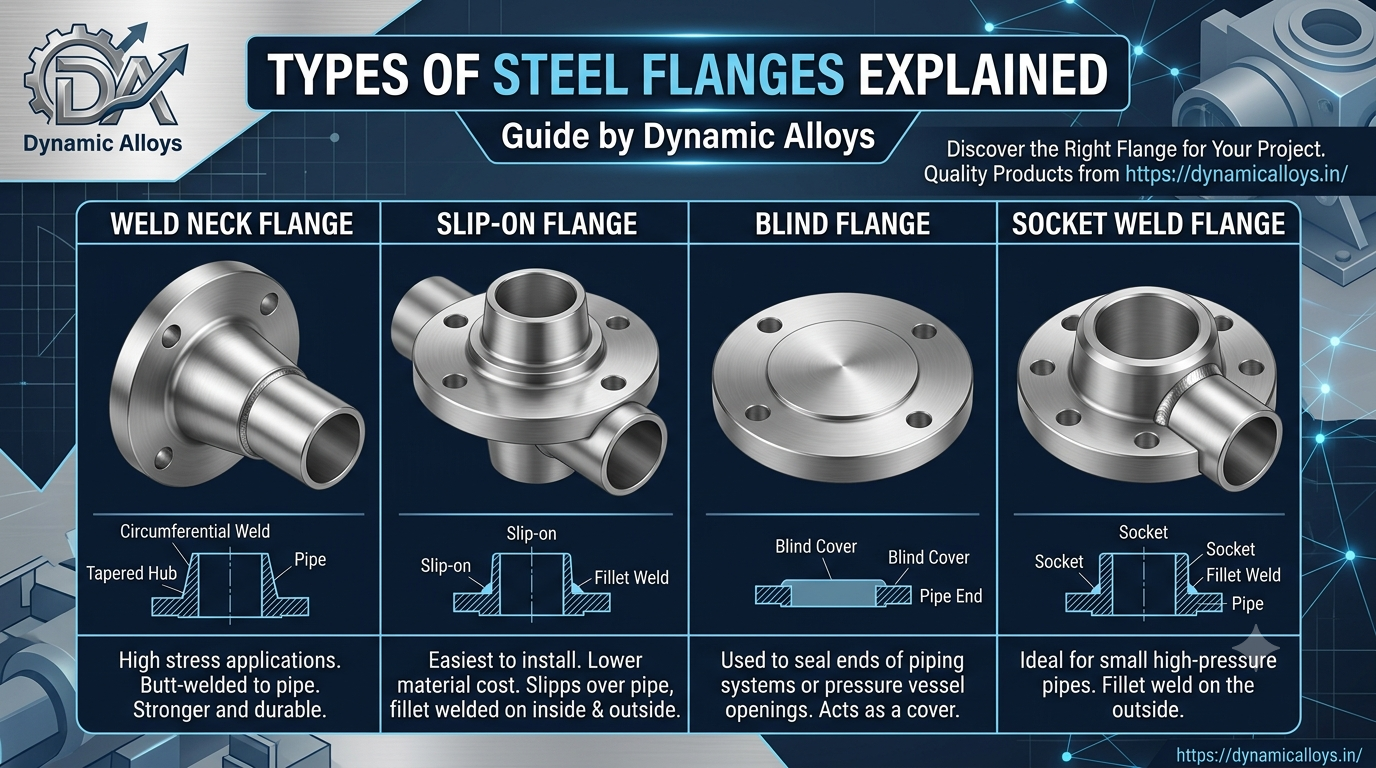
Slip-on flanges slide over the pipe and are fillet-welded at both the top and bottom. They are easy to align and install, and they cost less than most other types.
Best for: Low-pressure applications such as water supply, fire protection, and general industrial piping.
2. Weld Neck Flanges
Weld neck flanges have a long tapered hub that is butt-welded to the pipe. This design distributes stress evenly, reduces turbulence, and offers excellent strength and fatigue resistance.
Best for: High-pressure, high-temperature, and critical services in oil and gas, refineries, and power plants.
3. Blind Flanges
A blind flange has no bore. It is used to close the end of a piping system, valve, or pressure vessel opening. It also allows easy access for future inspection or modification.
Best for: Pipeline terminations, tank openings, and maintenance isolation.
4. Socket Weld Flanges
Socket weld flanges have a recessed area where the pipe is inserted before a single fillet weld is applied on the outside. They provide smooth flow and good structural integrity.
Best for: Small-diameter, high-pressure lines in chemical and hydraulic systems.
5. Threaded (Screwed) Flanges
Threaded flanges are screwed onto the pipe, so no welding is required. This makes them ideal where welding is unsafe or impractical.
Best for: Low-pressure utility lines and explosive or hazardous environments.
6. Lap Joint Flanges
Lap joint flanges are used with a stub end. The flange rotates freely around the pipe, which makes bolt-hole alignment simple.
Best for: Systems requiring frequent dismantling, such as inspection-heavy pipelines.
7. Orifice Flanges
Orifice flanges include tapped holes for pressure measurement. They are used with an orifice plate to measure flow rate in a pipeline.
Best for: Flow metering in oil, gas, and process industries.
How to Choose the Right Flange
Consider these factors before selecting:
- Pressure and temperature: Weld neck suits extreme conditions, while slip-on suits milder ones.
- Material grade: Options include carbon steel, stainless steel (304, 316), and alloy steel.
- Standards: ASME B16.5, ASME B16.47, ANSI, DIN, and EN.
- Media type: Corrosive or high-purity fluids may need specific grades.
- Maintenance needs: Frequent disassembly favors lap joint or threaded options.
Why Choose Dynamic Alloys?
Quality matters when failure is not an option. Dynamic Alloys is a leading steel flanges manufacturer India buyers trust for precision-engineered products that meet international standards. Our offerings include:
- A full range of flange types in carbon steel, stainless steel, and alloy steel
- Strict quality checks and material test certificates
- Custom sizes and pressure classes
- Timely delivery for domestic and export markets
Whether your project needs a simple slip-on flange or a heavy-duty weld neck flange, our team helps you select the right product for your application and budget.
Final Thoughts
Understanding flange types helps you build safer, more efficient piping systems. Each design serves a specific purpose, from the strength of weld neck flanges to the sealing role of blind flanges.
Looking for a reliable steel flanges manufacturer India can depend on? Contact Dynamic Alloys today for a quote and expert guidance on your next project.