
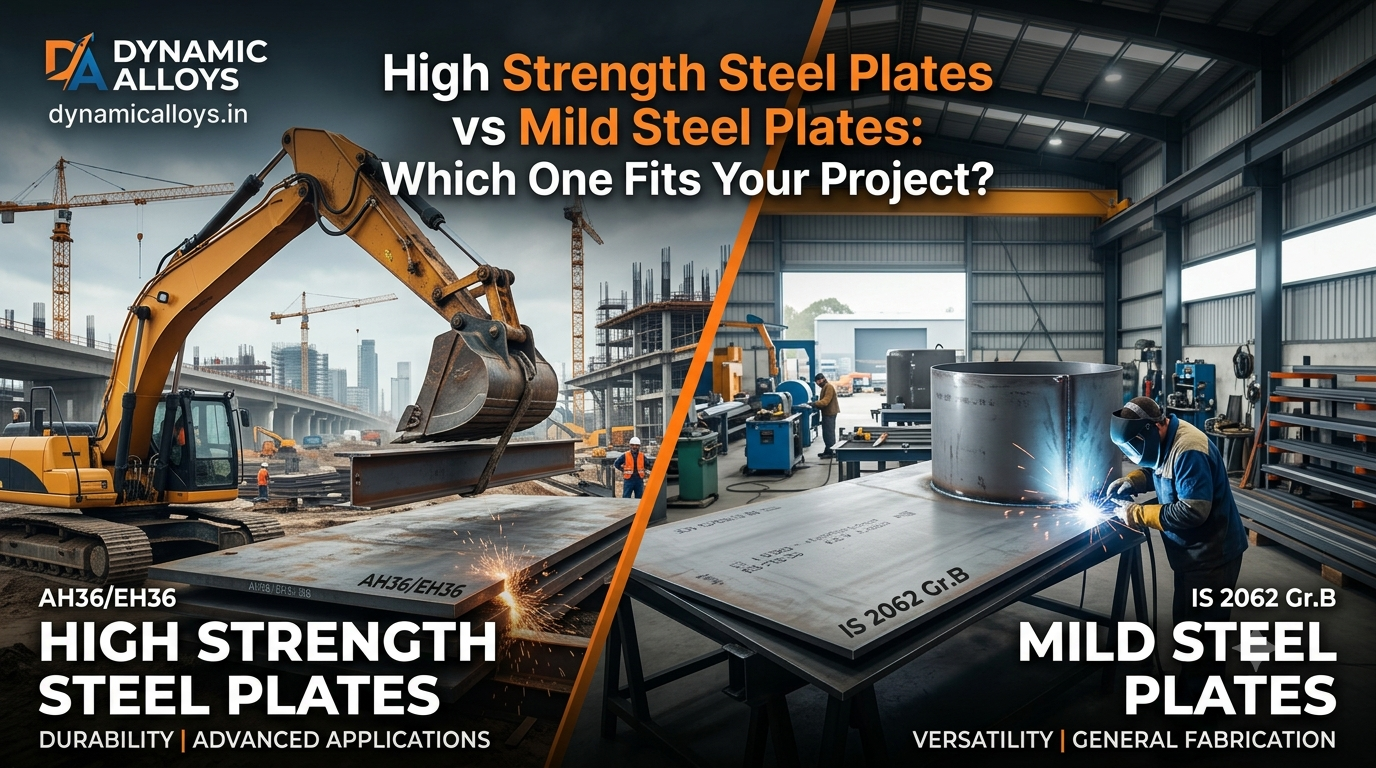
Choosing the right steel plate can decide whether your project is cost-efficient and durable or overbuilt and over budget. Two of the most common options are high strength steel plates and mild steel plates. At Dynamic Alloys, we help engineers, fabricators, and contractors make this choice every day. This guide breaks down the differences so you can decide with confidence.
What Are Mild Steel Plates?
Mild steel is a low-carbon steel, typically containing about 0.05% to 0.25% carbon. It is soft, ductile, and easy to cut, bend, and weld. Grades like IS 2062 E250 are widely used across construction and general fabrication.
Key advantages:
- Lower cost per tonne
- Excellent weldability and formability
- Easy machining and availability
- Good for non-critical structural uses
Limitations:
- Lower yield and tensile strength
- Heavier structures are needed to carry the same load
- Lower wear and abrasion resistance
What Are High Strength Steel Plates?
High strength steel plates are engineered with alloying elements such as manganese, chromium, nickel, molybdenum, and vanadium, often combined with controlled rolling or heat treatment. Yield strength typically ranges from 350 MPa to over 1,100 MPa, far above the roughly 250 MPa of mild steel.
When sourcing high strength steel plates India buyers commonly look at grades like S355, S460, Q345, Q690, and quenched and tempered options, depending on the application.
Key advantages:
- Higher load-bearing capacity
- Thinner, lighter plates for the same strength
- Better fatigue and impact resistance
- Longer service life in demanding conditions
Head-to-Head Comparison
| Factor | Mild Steel Plates | High Strength Steel Plates |
|---|---|---|
| Yield strength | ~250 MPa | 350 to 1,100+ MPa |
| Weight of structure | Heavier | Lighter |
| Weldability | Excellent | Good (may need preheating) |
| Upfront cost | Lower | Higher |
| Lifecycle cost | Higher in heavy-duty use | Often lower |
| Best for | General fabrication | Heavy-duty, load-critical work |
Which One Fits Your Project?
Choose mild steel plates if:
- Loads are moderate and conditions are not extreme
- Budget is tight and the structure is non-critical
- Heavy bending, forming, or easy welding is a priority
- You are building general structures, base plates, tanks, or frames
Choose high strength steel plates if:
- You need to reduce structural weight
- The application involves heavy loads, impact, or fatigue
- You are building cranes, bridges, pressure vessels, mining equipment, or heavy machinery
- Long-term durability and lower maintenance matter
Cost vs Value
Mild steel is cheaper per tonne, but high strength steel often saves money overall. Because you can use thinner plates, you reduce material weight, transportation costs, welding time, and foundation loads. For heavy-duty projects, the higher upfront price is frequently offset by lifecycle savings.
Tips Before You Buy
- Define load, temperature, and environmental conditions first.
- Check the required grade, thickness, and certification (mill test certificates).
- Consider welding procedures, especially for higher grades.
- Work with a supplier who offers technical guidance and consistent quality.
Why Choose Dynamic Alloys?
Dynamic Alloys is a trusted supplier of high strength steel plates India projects rely on, offering a wide range of grades, thicknesses, and custom cut sizes. We provide certified quality, competitive pricing, and expert support to help you match the right plate to your application, whether it is mild steel for everyday fabrication or high strength steel for demanding environments.
Final Thoughts
There is no universal winner. Mild steel suits cost-sensitive, general-purpose work, while high strength steel excels where performance, weight savings, and durability count. Understanding your project’s requirements is the key to the right choice.
Ready to find the right plate? Contact Dynamic Alloys today for a quote and expert guidance on high strength steel plates and mild steel plates for your next project.