
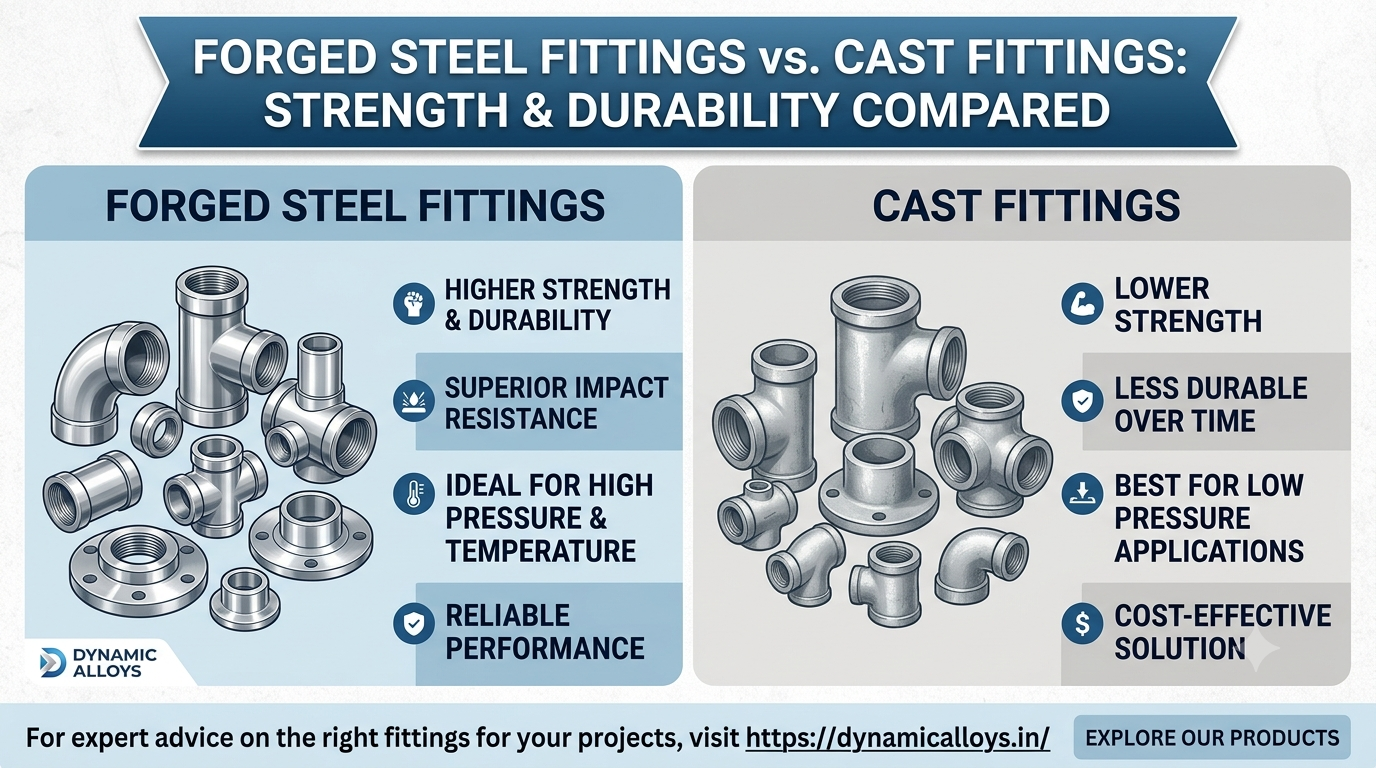
When specifying piping components for oil and gas, petrochemical, power, or water treatment projects, one decision comes up repeatedly: forged or cast? Both are widely used, but they differ significantly in strength, reliability, and lifespan. If you are sourcing forged steel fittings India buyers trust, understanding these differences will help you avoid costly failures and downtime.
How Each Type Is Made
Forged fittings are produced by heating a solid steel billet and shaping it under intense compressive force using presses or hammers. This process refines the metal’s grain structure and aligns it with the shape of the part.
Cast fittings are made by pouring molten metal into a mold and letting it solidify. This allows complex shapes at lower cost, but the cooling process can leave behind microscopic flaws.
Strength Comparison
Forging produces a dense, uniform grain flow that significantly improves tensile strength, impact resistance, and fatigue performance. Forged components handle high pressure and sudden load changes far better.
Cast fittings, by contrast, have a random grain structure. Porosity, shrinkage cavities, and inclusions can form inside the metal, creating weak points that may not be visible during inspection. Under high pressure or thermal cycling, these defects can become failure origins.
Durability and Service Life
| Factor | Forged Fittings | Cast Fittings |
|---|---|---|
| Grain structure | Refined, directional | Random, coarse |
| Tensile strength | High | Moderate |
| Impact resistance | Excellent | Limited |
| Porosity risk | Very low | Higher |
| Leak resistance | Superior | Good for low pressure |
| Best for | High-pressure, high-temperature | Low-pressure, large sizes |
Forged fittings resist corrosion, fatigue, and cracking over long service periods, which translates into fewer replacements and lower maintenance costs. Cast fittings can perform well in non-critical, low-pressure applications, but they typically wear out sooner in demanding environments.
Cost vs Long-Term Value
Cast fittings usually have a lower upfront price, particularly for large or intricate shapes. However, forged fittings deliver better total cost of ownership. A single leak or failure in a high-pressure line can cause shutdowns, safety hazards, and repair expenses that far exceed the initial savings.
Which Should You Choose?
Choose forged fittings for:
- High-pressure and high-temperature systems
- Hazardous or flammable media
- Critical process lines where safety is paramount
- Small-bore piping (typically up to 4 inches)
Choose cast fittings for:
- Low-pressure, non-critical applications
- Large diameter pipelines
- Complex geometries where forging is impractical
Why Dynamic Alloys for Forged Steel Fittings in India
Dynamic Alloys is a trusted supplier of forged steel fittings India industries rely on, offering elbows, tees, couplings, unions, crosses, and threaded, socket weld, and butt weld fittings. Available in carbon steel, alloy steel, and stainless steel grades, our products conform to ASME B16.11, MSS SP-79, and other international standards, and are backed by material test certificates and strict quality inspection.
Whether your project needs standard stock items or custom specifications, our team ensures reliable supply, competitive pricing, and timely delivery across India and worldwide.
Conclusion
For strength, durability, and safety, forged fittings clearly outperform cast ones in demanding applications. Choosing the right supplier is just as important as choosing the right type.
Looking for premium forged steel fittings in India? Contact Dynamic Alloys today for a quote and expert technical guidance.