
Choosing the right pipe fitting affects the safety, cost and lifespan of your piping system. Two of the most common options in industrial piping are buttweld and socket weld fittings. At Dynamic Alloys, a leading buttweld fittings manufacturer India industries rely on, we are often asked how the two differ and when to use each. This guide explains the key differences.
What Are Buttweld Fittings?
Buttweld fittings are joined by welding the beveled end of the fitting directly to the beveled end of the pipe. The result is a continuous, full-penetration weld with a smooth inner surface. Common types include elbows, tees, reducers, caps and stub ends, typically manufactured to ASME B16.9.
What Are Socket Weld Fittings?
Socket weld fittings have a recessed “socket” into which the pipe is inserted. The joint is then secured with a fillet weld around the outside. They are usually made to ASME B16.11 and are available in pressure classes such as 3000, 6000 and 9000.
Key Differences at a Glance
1. Weld type and joint strength
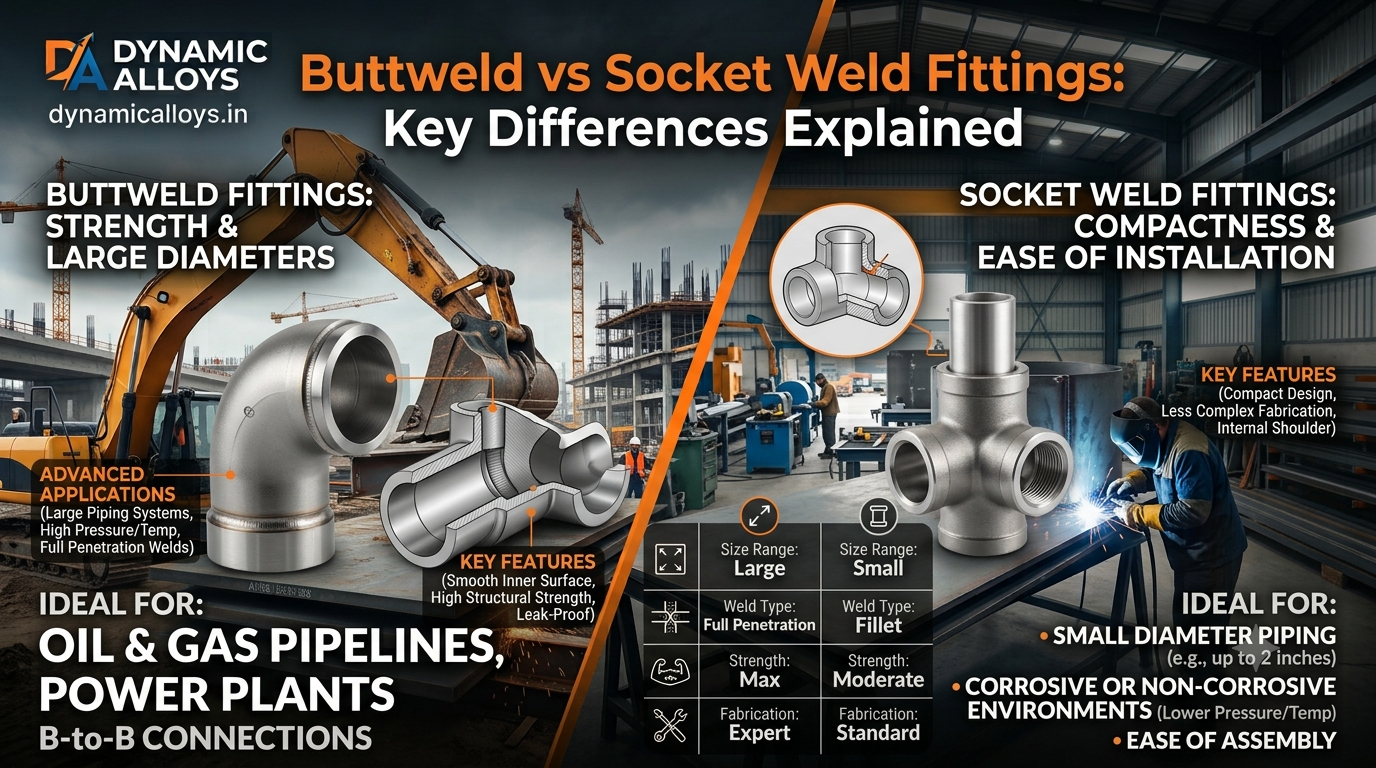
Buttweld joints use full-penetration welds, which produce a strong, seamless connection. Socket weld joints rely on a fillet weld, which is reliable but generally less robust under extreme stress.
2. Flow characteristics
Buttweld fittings give a smooth bore with minimal turbulence and pressure drop. Socket weld joints leave a small gap and internal step, which can disturb flow.
3. Size range
Buttweld fittings suit a wide range of sizes, from small bore to very large diameters. Socket weld fittings are mainly used for small-bore piping, typically NPS 4 and below.
4. Leak resistance and corrosion
Because buttweld joints have no crevices, they are better for corrosive or hygienic services. Socket welds can trap fluid in the gap, which may lead to crevice corrosion.
5. Inspection
Buttweld joints can be thoroughly checked with radiographic (X-ray) testing. Socket welds are usually inspected by visual, dye penetrant or magnetic particle methods.
6. Installation and cost
Socket weld fittings are easier to align and fit, and they need no beveling, which speeds up installation on small lines. Buttweld joints demand more skilled welders and precise fit-up, but they pay off in long-term performance.
Which One Should You Choose?
Choose buttweld fittings for high-pressure, high-temperature, corrosive or large-diameter systems, such as oil and gas, petrochemical, power and chemical plants. Choose socket weld fittings for small-bore, high-pressure lines like instrumentation, hydraulic and steam services, where quick installation matters.
Why Dynamic Alloys?
Quality is critical when your system carries pressure, heat and hazardous media. As an experienced buttweld fittings manufacturer India buyers trust, Dynamic Alloys supplies elbows, tees, reducers and caps in stainless steel, carbon steel and alloy steel. Our products are made to international standards, with strict dimensional checks, material traceability and testing for every batch. Whether you need standard sizes or custom specifications, we deliver on time and to the quality your project demands.
Final Thoughts
Neither fitting is universally better. Buttweld fittings excel in strength, flow efficiency and inspectability, while socket weld fittings offer convenience for smaller lines. Match the choice to your pressure, size, media and budget.
Need reliable fittings for your next project? Contact Dynamic Alloys today for a quote from a trusted buttweld fittings manufacturer in India.